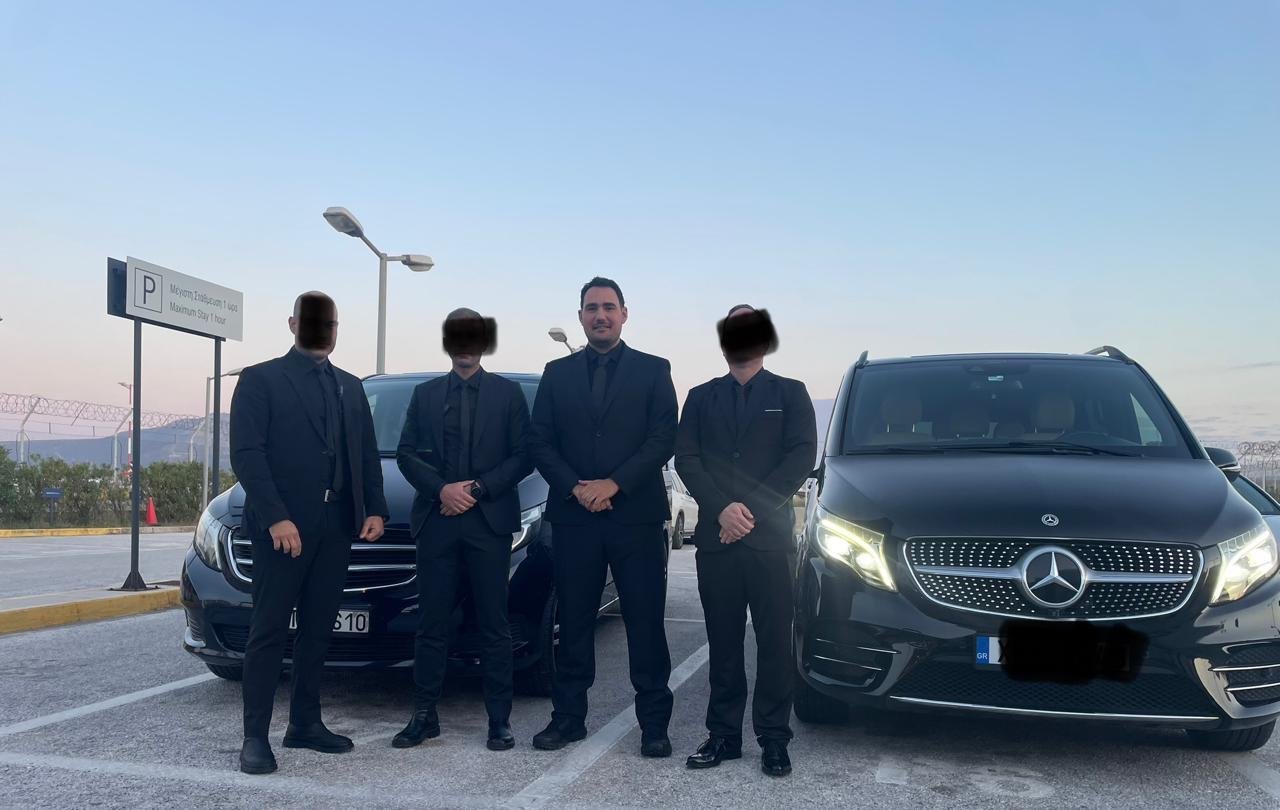
Operational support team and secure transportation capability activated in Athens during the crisis response. Identifying details have been obscured for privacy and operational security.
A multi-layered crisis response in the Eastern Mediterranean, combining aviation contingency planning, executive protection, secure transportation and international operational coordination.
Read Case Study All Case Studies
Operational support team and secure transportation capability activated in Athens during the crisis response. Identifying details have been obscured for privacy and operational security.
An international private organisation was conducting important business activity in Israel when a rapidly escalating regional security crisis fundamentally changed the operating environment. A senior company representative was already in the country, while a separate group of senior corporate executives was travelling toward the region by private aircraft.
As the aircraft approached the destination region, the security situation deteriorated rapidly and airspace restrictions made the original travel plan no longer viable. At the same time, the representative already inside the country faced significant restrictions on normal onward travel.
XN Consultancy activated its international operational network and managed two parallel requirements: supporting the diverted executive delegation through Greece while simultaneously coordinating an alternative extraction and onward-movement solution for the representative already within the crisis area.
The situation demonstrated how quickly geopolitical developments can become direct corporate-security and business-continuity problems — even when the organisation itself is not a participant in the underlying conflict.
The organisation had been pursuing significant commercial activity in the region. A senior representative had travelled ahead to support preparations, while additional senior executives were scheduled to arrive separately to continue the business programme.
The original travel arrangements were conventional for a high-level corporate mission: a direct aviation movement, scheduled meetings and a defined business itinerary.
That operating picture changed abruptly when military escalation affected regional airspace and transportation. The original aviation plan could no longer be treated as reliable, while the company representative already on the ground faced an increasingly constrained mobility environment.
A problem that had initially been commercial and logistical therefore became a security, evacuation and continuity challenge.
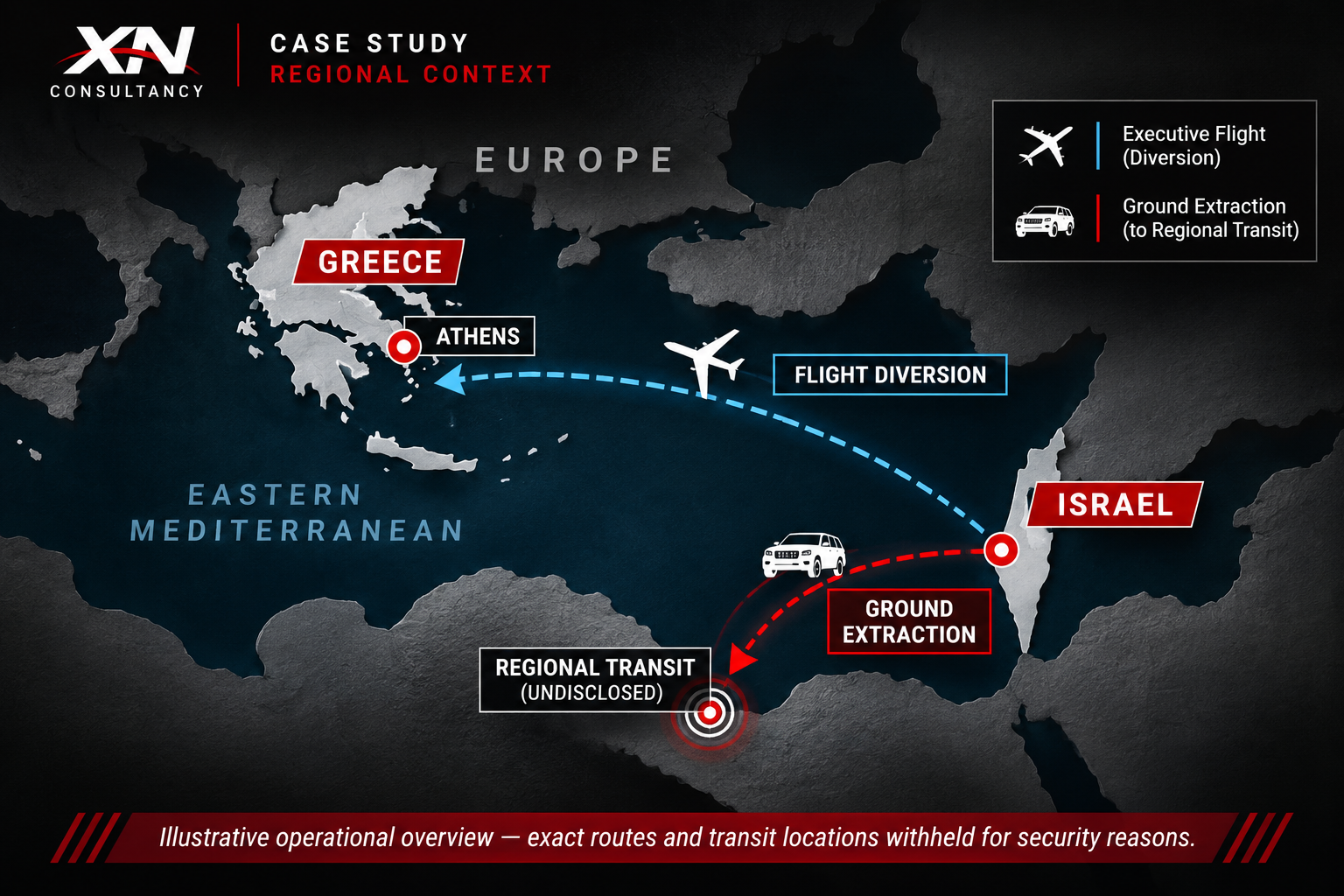
Illustrative operational overview. Exact routes and transit locations are intentionally withheld for security reasons.
The primary challenge was not simply the diversion of an aircraft or the movement of one individual. Two separate operational problems were developing at the same time and both required immediate attention.
The situation therefore required more than a transportation solution. It required a continuously updated operational picture and the ability to develop alternative options as conditions changed.
The original travel plan was no longer treated as the baseline. The first requirement was to reassess the situation around three questions: where the travellers could be safely received, how the company representative could leave the affected environment, and how both groups could continue toward suitable onward destinations.
Rather than treating these as unrelated problems, they were managed as components of one crisis-response requirement. This allowed security, transportation, aviation and local-support decisions to be coordinated around the wider corporate objective.
Athens offered an appropriate support node for the diverted executive group. Local operational capability could be activated quickly, secure transportation could be coordinated and suitable onward travel arrangements could subsequently be developed.
At the same time, the representative already inside the affected area required a different solution. With normal aviation channels restricted, the planning focus shifted toward controlled ground movement to a regional transit point from which international onward travel remained available.
The response therefore depended on maintaining parallel plans while ensuring that each action remained adaptable to the changing regional security environment.
Two distinct operational requirements were managed simultaneously.
The executive aircraft was supported through diversion to Athens rather than continuing toward the original destination.
Local arrangements were activated for reception of the travellers, secure ground transportation and suitable accommodation.
Once the immediate disruption had been stabilised, alternative private aviation arrangements were coordinated so the executives could continue their international business programme.
In parallel, an extraction solution was developed for the senior representative already within the affected environment.
Security operators supported controlled ground movement toward a regional transit point where viable international aviation options remained available.
Through a sequence of coordinated onward movements, the individual was ultimately able to continue safely toward the final home destination.
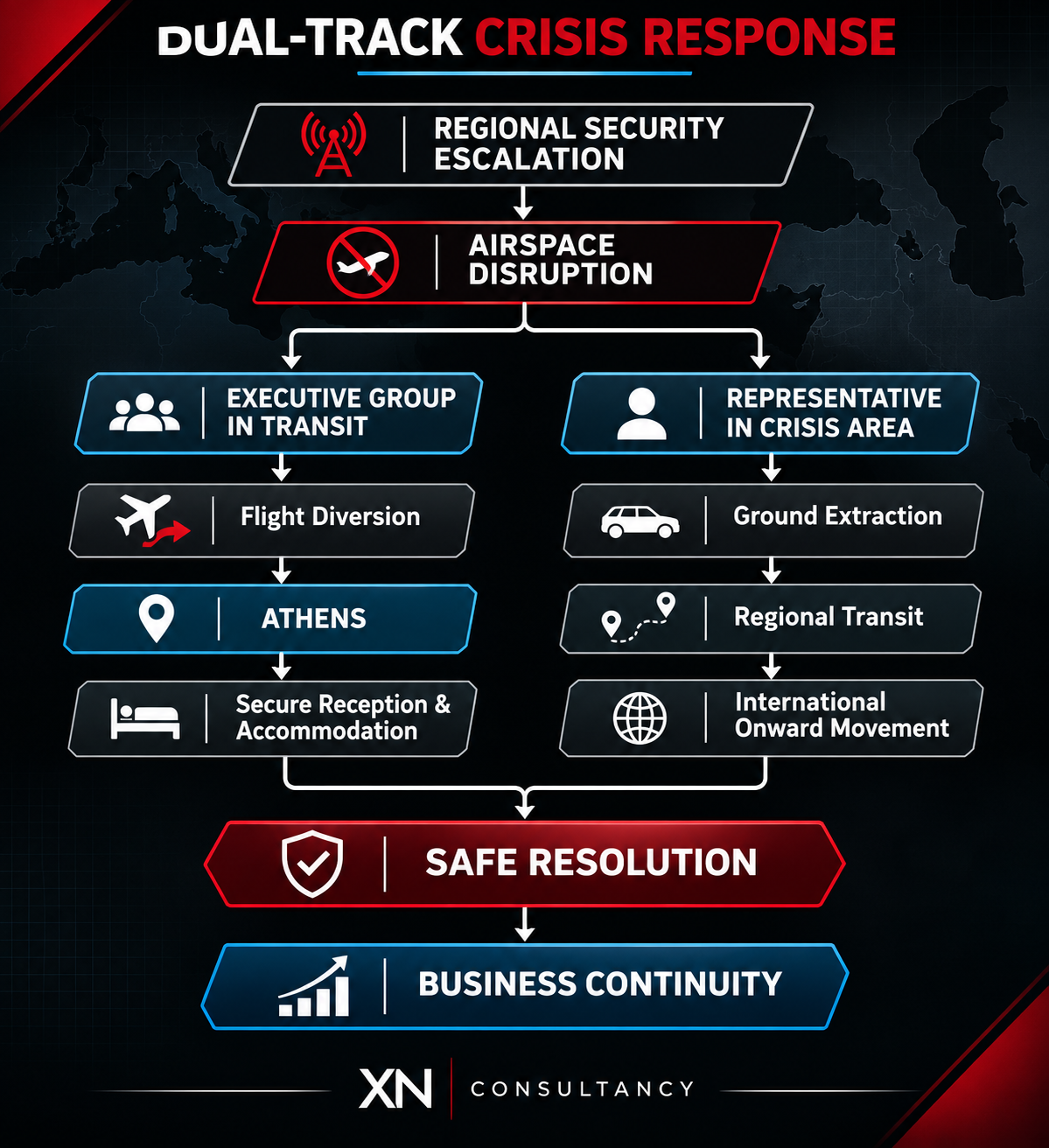
Two operational requirements were managed simultaneously: support for the diverted executive group and extraction of the representative already within the crisis environment.
Senior corporate personnel were moving toward the region while a company representative was already operating locally.
The operating environment deteriorated rapidly and the original aviation and travel arrangements became unreliable.
XN Consultancy activated local and international operational capabilities and began developing alternative movement options.
The executive group was supported through diversion to Athens, where reception, secure movement and accommodation arrangements were established.
A separate ground-movement solution was coordinated for the representative already inside the affected environment.
Alternative aviation options enabled both operational tracks to progress toward appropriate onward destinations.
Both requirements were completed safely while the organisation retained the ability to continue its wider business activities.
The executive delegation was received safely in Greece and supported through secure transportation, accommodation and alternative onward travel arrangements.
The representative who had been unable to rely on normal commercial aviation channels was moved through an alternative regional route and subsequently continued safely toward the final destination.
The response achieved its primary objective: protecting personnel while preserving the client's ability to continue operating despite a major geopolitical disruption.
No single component solved the problem independently. The outcome depended on combining local operational capability, international partners, transportation, aviation alternatives, security coordination and adaptable decision-making.
Organisations do not need to be direct targets of a conflict to experience serious operational consequences. Airspace closures, disrupted transportation and restrictions on personnel movement can rapidly affect corporate activity.
High-level international travel requires alternative routes, support locations and contingency arrangements that can be activated when the original plan becomes impossible.
A trusted international network becomes valuable when an organisation requires immediate local execution in more than one jurisdiction at the same time.
Protecting personnel is the first priority, but effective crisis management should also help the organisation preserve operational continuity wherever this can be achieved safely.
Modern corporate security increasingly requires the integration of physical security, travel risk management, crisis response, evacuation planning, transportation and resilient operational networks.
This case study is based on a real operational requirement. Certain information has been removed, generalised or anonymised in order to protect client confidentiality, individual privacy and operational security.
Client identity, individual identities, precise timelines, detailed routes, accommodation locations, transit arrangements, communications procedures and other sensitive operational details are intentionally not disclosed.
Executive and protective-security support for international clients operating or travelling in Greece.
View Service →Security drivers, secure ground transportation and journey management for executive movements.
View Service →Security risk assessment, crisis planning, preparedness and operational-resilience support.
View Service →If your organisation has executives travelling internationally, operates in complex environments or requires crisis-response and evacuation capability, XN Consultancy can support the development and execution of appropriate security arrangements.
Request Operational Support